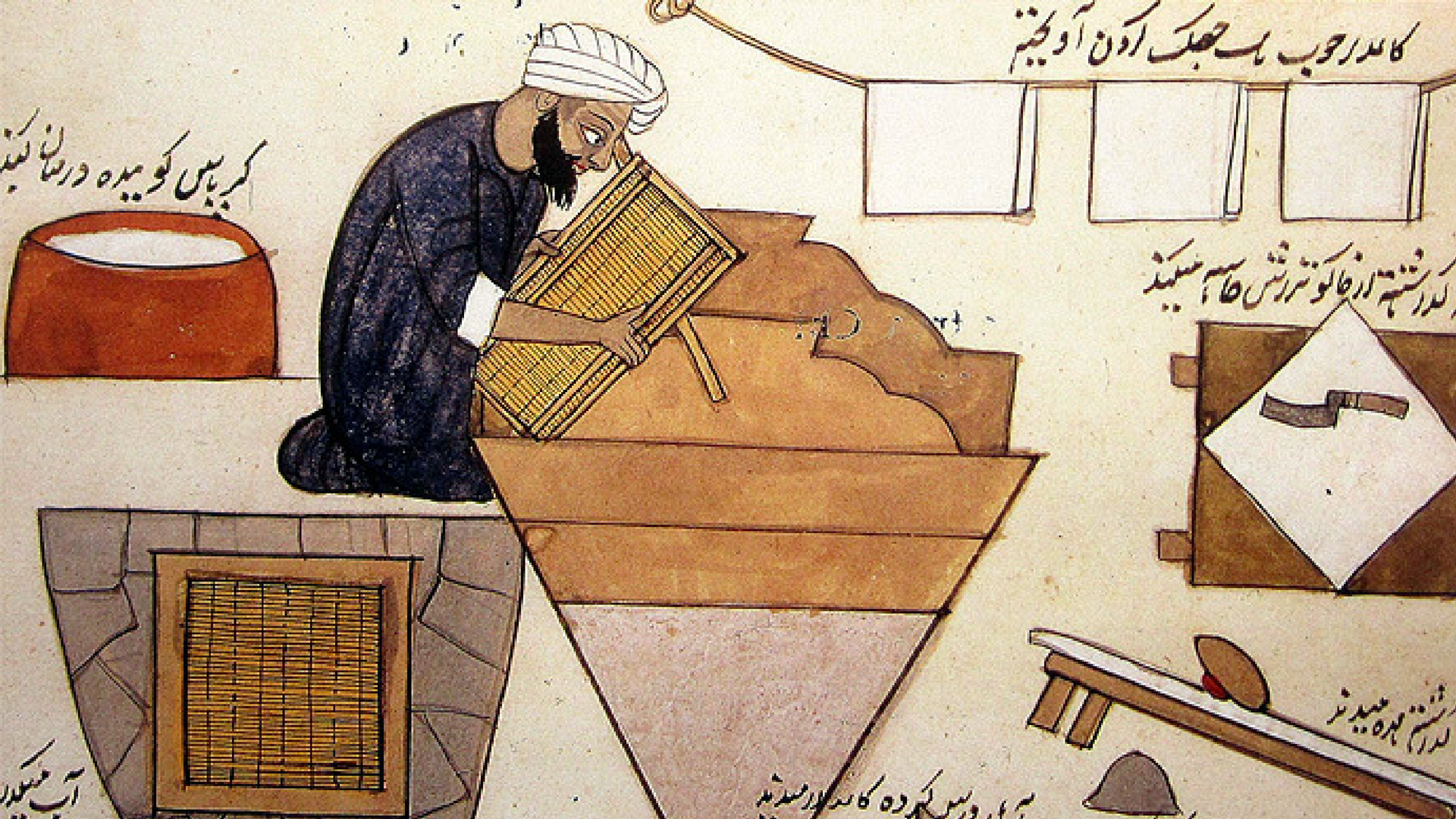
Paper seems such an ordinary product today, but it has been fundemental to modern civilisation. 1,100 years ago people were manufacturing paper in Baghdad in Muslim Civilisation.
It is believed that the secrets of Chinese paper making were passed on to the people of Baghdad around the year 751.
Very quickly, the art of paper-making was refined and transformed into mass production by the mills of Baghdad. Some of the techniques employed in Baghdad included the use of linen as a substitute for thr bark of the mulberry which the Chinese used. This involved a more refined and improved method of production.
This development facilitated the build of many paper mills in Baghdad from where the industry spread to Damascus which became the major source of supply of paper to Europe; and various other places around the world.
After the industry fllourished in Iraq, Syria and Palestine, it spread west. The first paper mill in Africa was built in Egypt around 850; then a paper mill was built in Morocco from where it reached Spain in 950. In 1293 the first paper mill in Bologna was set up. The first use of paper in England did not come until 1309, then Germany in the late stages of the 14th century.
Read More: www.muslimheritage.com/article/beginning-paper-industry

The tools and technique of making paper leaf depicted in a volume illustrating crafts and trades, Kashmir (Source) – British Library: “Making Islamic-style paper“

Two folio pages (239b – 241b ) of the manuscript Or. 298 at Leiden University Library, which is probably the oldest known Arabic manuscript on paper (dated Dhu al-Qa`da 252 (866 CE). Arabic, paper, 241 ff., upright script (with application of ihmal), bound in a full-leather standard binding. The present volume contains an incomplete copy of Gharib al-Hadith, by Abu `Ubayd al-Qasim b. Sallam al-Baghdadi (d. 223 H/837 CE). (Source) Muslim Heritage: “Filling the Gap in the History of Pre-Modern Industry: 1000 Years of Missing Islamic Industry” by Professor Salim Al-Hassani

[Perron, Nicolas.] Al-Azhar al-badi’a fi ‘ilm al-tabi’a. Translated by Yuhanna ‘Anturi. Bulaq, 1254 [1838]. Muslim Heritage: “Manuscripts and printing in the spread of Muslim science” by Geoffrey Roper

Another interesting book published by Ibrahim Muteferrika Press, was a history of the discovery of America. Printed towards the beginning of April, 1730, it is the first Islamic printed book with figural illustrations. Based partly on Latin sources, the History of the West Indies contains an introduction on the geographical views of ancient writers -showing their ignorance of the New World -and then gives an account of the Spanish discoveries, including fabulous stories of the flora and fauna of the New World, illustrated by 13 prints and four maps, engraved by Ibrahim.
Muslim Heritage: “Arabic and the Art of Printing” by Saudi Aramco World Magazine
Taken from http://1001inventions.com/paper