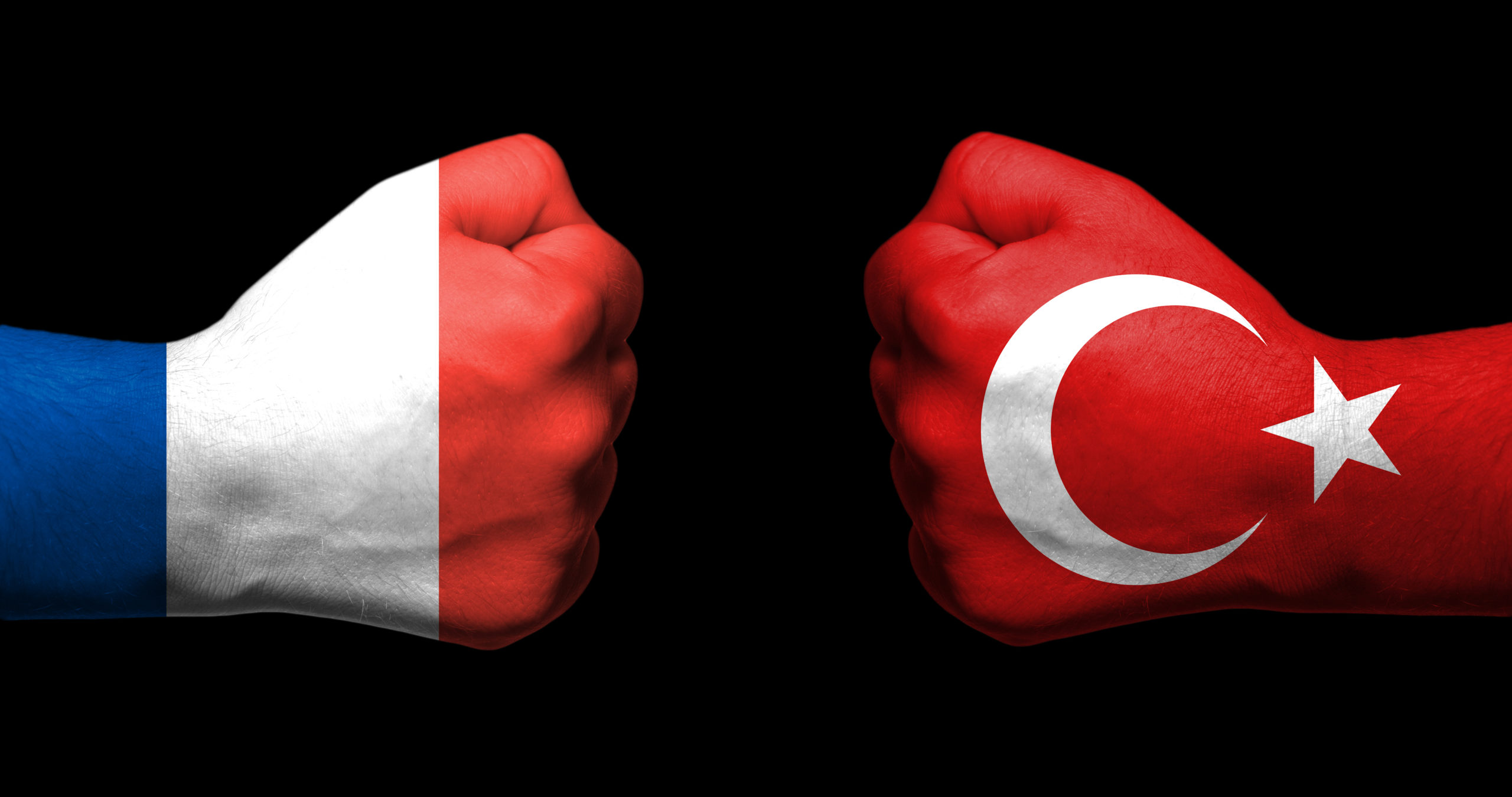
France and Turkey trading blows
Ever since the beginning of Turkey’s Military operation in Syria last month, their relationship with France has deteriorated, as France reacted negatively and fiercely to the operation, while Turkey responded with insistence and jabs of equal magnitude.
Most recently, French President Macron said in an interview three weeks ago there was a lack of strategic coordination between European allies on the one hand and the United States and Turkey, on the other. He has also decried NATO’s inability to react to what he called Turkey’s “crazy” offensive into northern Syria.
The comments drew a stinging rebuke from Erdogan during a televised speech on Friday. “Have your own brain death checked. These statements are suitable only to people like you who are in a state of brain death,” Erdogan said. “You know how to show off but you cannot even properly pay for NATO. You are a novice,” he added.
On Friday, French officials said they expected substantial clarifications from Erdogan rather than a war of words. “Let’s be clear, these are not statements, they are insults,” a presidential adviser said. “The president says things clearly. It’s up to Turkey to provide the answers that we and many allies expect.” Macron’s adviser said that beyond the issue of Turkey’s offensive in Syria, its refusal to back a NATO defence plan for the Baltic republics and Poland was unacceptable. “Turkey can’t take the defence plans of Poland and the Baltic countries hostage,” the adviser said.
It seems relations have only gotten worse in recent weeks, which is a major problem for NATO, as it disrupts its unity and functionality as a whole.
Turkey sending ISIL members back to France
Another factor adding fuel to the heated state of relations between Turkey and France is Turkey’s decision and insistence in sending ISIL members back to France despite strong opposition.
As part of Turkey’s policy of repatriating foreign ISIL members to their home countries, 11 French national members of the terror group will be sent back to France at beginning of December, Turkish interior minister said on Nov. 28 “This week we will carry out repatriations to Belgium and Ireland on [Nov. 29] and [Nov. 30]. Also, we will send 11 French national Daesh members back to France at the beginning of December,” Süleyman Soylu said, using the Arabic acronym for ISIL.
Furthermore, Erdogan warned France and the other European nations that he would continue to do this, which appears to send the wrong signal.
“We have started returning Daesh members to their countries and of course there is a serious rush, things are flaring up,” Mr Erdogan told reporters, using the Arabic acronym for the Islamic State. He added that the onus had been on Turkey to handle the exodus of Islamic State fighters from Syria and that now their home countries must decide what to do.
It appears that this continuance will continue to be an obstacle to solving the geopolitical spat between the 2 nations, and will be a subject of debate in the NATO summit which will be mentioned in point 3.
Hopes for the upcoming NATO summit to mend differences
Tensions between Turkey and France have flared in recent weeks, but there is hope for a resolution of this split in the upcoming NATO summit, in which many members are hoping to mediate the dialogue between the 2 nations.
Turkey, Germany, France and the U.K. will hold a quadrilateral meeting in the context of Syria, on the sidelines of the NATO summit on Dec. 3 and Dec. 4, Turkey’s presidential spokesman has announced. “Our president has previously said that such a meeting should take place in Istanbul, Şanlıurfa or Gaziantep. We still think like this because of the Syrian issue and the refugees have been happening within and next to Turkey. We believe that Turkey is the right address for such a meeting,” İbrahim Kalın said on Nov. 8.
The idea of a four-nation meeting on Syria was suggested by British Prime Minister Boris Johnson last month, after Turkey’s military operation against terrorist groups in northern Syria.
However, there are fears that this meeting and dialogue could worsen relations even further, as Turkey presents its adamant position face to face and so does France, the outcome remains to be seen, and will be crucial to the efficiency of NATO in the next months.